
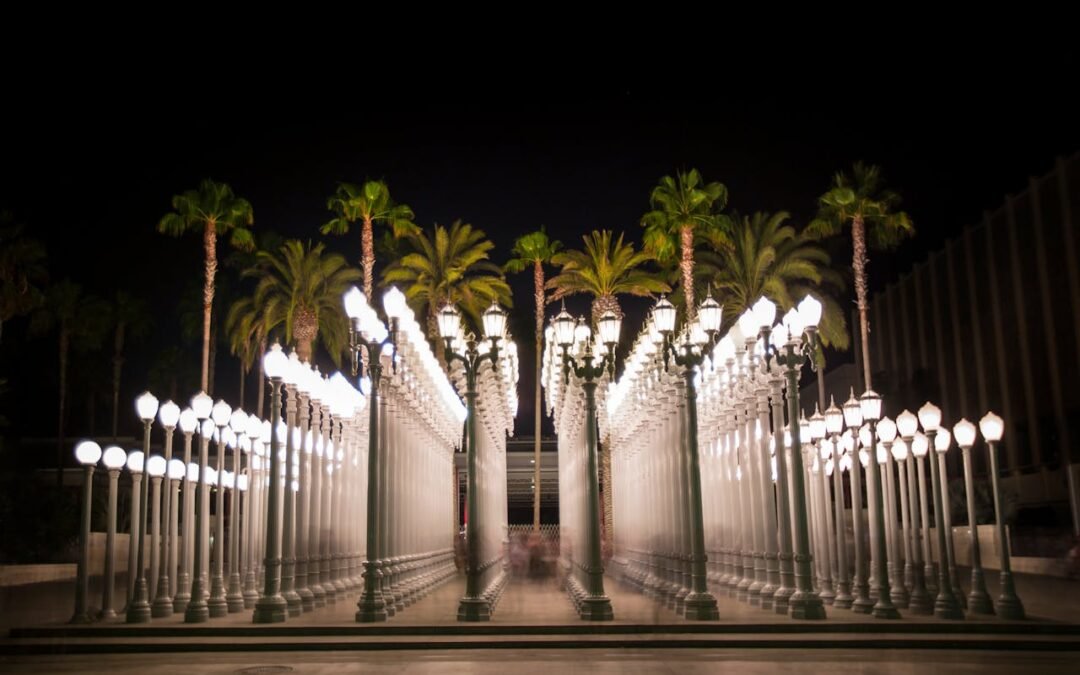
There’s a moment that happens at dusk on Wilshire Boulevard when the 202 cast-iron streetlamps on the museum plaza begin to assert themselves against the darkening sky. During the day, the LACMA lights feel historical — weathered columns with their own provenance, each lamp rescued from a different American city, arranged by Chris Burden into a grid that breathes differently depending on where you stand inside it. But as the natural light drops and the urban lights LACMA Los Angeles installation takes over, something shifts. The scale becomes apparent. The rhythm becomes physical. People walking through go quieter without being asked to.
That installation — the LACMA lamps on the Wilshire side of the campus — is free to access at any hour, which means the art museum Los Angeles experience here begins before you’ve bought a single ticket. It’s a useful introduction to what the Los Angeles County Museum of Art actually is: an institution that doesn’t wait for you to come inside before it starts doing something to you.
Los Angeles County Museum of Art — Scale That Photographs Badly and Feels Huge in Person
The los angeles county museum of art los angeles CA campus sits at 5905 LACMA Wilshire Boulevard Los Angeles CA, in the Miracle Mile district between Koreatown and Fairfax. The La Brea Tar Pits press directly against the eastern edge. The Peterson Automotive Museum faces it from across the street. The Craft Contemporary sits in the same block. What this means practically is that a full cultural day built around the LACMA art museum Los Angeles can stay within walking distance of itself and still cover several distinct institutions.
Inside, the Los Angeles County Museum of Art holds more than 142,000 objects. That number lands differently once you’re actually walking through — the lacma museum is the largest art museum in the western United States by collection size, and the difference between knowing that and experiencing it is real. One hour in the Ahmanson Building covers European and American painting from medieval altarpieces through Impressionism. The Hammer Building handles modern and contemporary work. The Pavilion for Japanese Art — designed by Bruce Goff — is a naturally lit structure that houses Japan-related holdings in an atmosphere that genuinely changes how you breathe inside it. I noticed on my first visit that the Japanese Pavilion produces involuntary quiet. Not silence exactly. Just a different pace.
The LACMA art museum is the kind of place where you decide, after your second or third visit, that you’ve been approaching it wrong — that the right method is to pick one floor, one period, one thread, and follow it without trying to see the complete collection in a single afternoon. Visitors who arrive with comprehensive intentions leave exhausted. Visitors who arrive with a specific curiosity leave satisfied.
LACMA Exhibits — Why the Rotating Program Is Worth Tracking Separately
Beyond the permanent holdings, the LACMA exhibits calendar runs serious temporary programming year-round. The lacma museum has mounted major retrospectives on Yoshitomo Nara, Henri Matisse, Guillermo del Toro’s cabinet of curiosities, and Stanley Kubrick. Thematic shows examining Latin American modernism, LA-based artists, global photography. The lacma exhibits rotate with enough frequency that a visitor who came six months ago and comes again now may find the museum substantially different in emphasis.
This matters for practical reasons: checking what LACMA exhibits are running before you visit changes what the most important reason to go actually is. The permanent collection is reliable and large enough to justify any visit, but the temporary shows occasionally make the LACMA art museum Los Angeles the only place in the world to see a specific thing at a specific moment. Those moments are worth knowing about in advance.
LACMA Los Angeles Tickets — What You Pay and How to Buy
LACMA Los Angeles tickets currently run approximately $25 for adults, with reduced rates for seniors, students, and children under 17. LACMA museum tickets cover both the permanent collection and most temporary lacma exhibits, which distinguishes the LA art museum from institutions where major shows carry a separate surcharge. LACMA Los Angeles tickets are purchasable online — recommended for weekends and for any visit timed around a major traveling exhibition. Walk-up availability during blockbuster shows is not guaranteed, and the queue difference between having LACMA tickets in advance and arriving without them can be significant on a Saturday afternoon.
LACMA free days for LA County residents provide reduced or free entry on specific dates — historically the second Tuesday of each month for certain categories, though the current structure shifts with programming cycles. The lacma museum tickets page on the official site has the current schedule. Children under 17 with an LA County address are generally free regardless of the day. For LACMA free days to work smoothly, an advance reservation is still required in most cases — free entry doesn’t mean unmanaged entry.
LACMA Opening Hours and What Changes on Fridays
LACMA opening hours run Thursday through Tuesday, roughly 11AM to 6PM on most days. Wednesday is the standard closure. LACMA hours extend on Fridays — the museum stays open until 8PM, and the extended lacma Los Angeles hours on Fridays are timed specifically around the jazz programming that runs in the outdoor courtyard most of the year.
LACMA museum hours shift for holidays and occasional special events, so verifying lacma opening hours on the official site before a visit is the practical recommendation rather than assuming the standard schedule. For evening visitors coming specifically for the Urban Lights LACMA Los Angeles installation, the lacma lights Los Angeles CA are accessible from the street side of the campus at all hours — LACMA museum hours don’t govern the outdoor plaza.
LACMA Jazz Music — the Friday Night Tradition Most LA Residents Haven’t Discovered Yet
Jazz at LACMA on Friday evenings is one of the most persistently underrated recurring events in Los Angeles. LACMA jazz nights run most Fridays from spring through fall in the BP Grand Entrance — the open-air courtyard between the Ahmanson and Hammer buildings — and the lacma jazz music programming draws from the full range of the tradition. Bebop, Latin jazz, contemporary improvisation, fusion. The quality is consistently high. The setting is better than most dedicated venues in the city.
LACMA jazz is free. No LACMA Los Angeles tickets required. The lacma jazz nights attract a genuinely mixed crowd — lifelong jazz listeners who’ve been coming for years, families with blankets on the courtyard edges, people who wandered in from the street and stayed two hours longer than they planned. Jazz at LACMA works in part because the outdoor space — the sound moving across the courtyard, the palm trees visible above the building line, the museum buildings lit behind the stage — produces an atmosphere that a purpose-built venue wouldn’t replicate even if it tried.
LACMA lights in LA after the music ends and the crowd disperses have a particular quality. The lacma lamps on the Wilshire side still burning. The city moving around them. Worth staying for, if the Friday evening permits it.

LACMA Parking — the Honest Version
LACMA parking in the museum structure on 6th Street runs on an hourly basis — typically around $20 for a standard visit of a few hours. LACMA parking validates for members. Street parking in the surrounding Miracle Mile neighborhood is metered and competitive on weekends, particularly on Friday evenings when LACMA jazz music nights bring additional foot traffic to the area.
The Wilshire/Western Purple Line station is within walking distance of the campus — around 15 minutes on foot — which makes the LA Metro a genuine option for visitors coming from Hollywood, Koreatown, or downtown. For groups, families with young children, or anyone arriving from the east side of the city, the structured LACMA parking is more reliable even at the cost.
The Museum of Contemporary Art in Los Angeles — a Different Institution, Worth Knowing Separately
The museum of contemporary art in Los Angeles operates independently from the LACMA art museum and serves a different part of the Los Angeles art museum landscape. The museum of contemporary art Los Angeles — commonly known as MOCA — focuses specifically on art created from the 1940s onward, with a permanent collection that includes major works by Mark Rothko, Jackson Pollock, Lee Krasner, and a strong body of California-based artists from the post-war decades.
The museum of contemporary art Los Angeles runs two locations: the main building on Grand Avenue downtown, designed by Arata Isozaki, and the Geffen Contemporary in Little Tokyo. The la museum of modern art Los Angeles isn’t an official name — people use it loosely to refer to MOCA, which is technically the museum of contemporary art rather than a museum of modern art — but the distinction matters less than knowing that the museum of contemporary art in Los Angeles and the LACMA museum LA are separate institutions with separate tickets, separate programming, and different geographic positions in the city.
If you plan to visit both the Museum of Contemporary Art Los Angeles and the Los Angeles County Museum of Art in one day, keep in mind that they are quite far apart. The Museum of Contemporary Art is downtown, while LACMA is on Wilshire in the Miracle Mile area. Each museum is worth spending a few hours at. Visiting both in one day can be rushed, so it’s usually better to spread them out over two days unless you are determined to see as much art as possible in a single trip.
LACMA Lights Los Angeles CA — Why the Installation Reads Differently at Different Hours
The LACMA lights Los Angeles CA installation — officially titled “Urban Lights” — consists of 202 antique cast-iron streetlamps, each collected from cities across the United States and restored before installation. LACMA museum urban lights went in permanently in 2008 and has been a fixture of the LA visual landscape ever since. Urban lights LACMA Los Angeles is technically a permanent artwork in the museum’s collection, which means it benefits from the same conservation attention as the objects inside the building.
LACMA lights in LA after dark are the version most people photograph, but the lacma lamps at other times carry their own quality. In early morning, before the street traffic builds, the lamps have a quiet authority — historical objects standing in the contemporary city without apology. In full afternoon sun, the shadows they cast across the plaza make the concrete feel patterned in a way that changes as you move. The LACMA lights Los Angeles CA experience is genuinely different across the day, and visitors who’ve only seen the nighttime version are missing part of what the installation does.
LACMA Wilshire Boulevard Los Angeles CA — the Neighborhood and What Surrounds the Museum
5905 LACMA Wilshire Boulevard Los Angeles CA places the museum at the center of a corridor with legitimate cultural density. The La Brea Tar Pits to the immediate east operate independently and provide a natural history experience that pairs well with the art museum Los Angeles visit — active excavation is visible from the park, which has a quality unlike almost anything else in the city. The Peterson Automotive Museum across Wilshire is exactly what it sounds like, and surprisingly compelling even for non-car people when the exhibitions are well-curated. The Craft Contemporary museum, walking distance from the LACMA museum, focuses on functional art and craft traditions and is chronically undervisited given the quality of its programming.
The LACMA art museum Los Angeles restaurants and cafés on the campus have improved considerably with recent renovations. The Ray’s and Stark Bar space adjacent to the sculpture garden serves as a reliable post-visit option. The Mid-Wilshire restaurant corridor on both sides of the museum provides good choices for before or after the visit, with the Koreatown options to the east representing some of the better value dining in the city.
After the Los Angeles County Museum of Art — Where the Day Can Go Next
A serious LACMA museum visit — three hours through the permanent collection plus whatever lacma exhibits are running — produces a specific kind of productive fatigue. The mind has been working in a particular mode: slow, contemplative, visually absorbing. The rest of the afternoon needs something that engages differently.
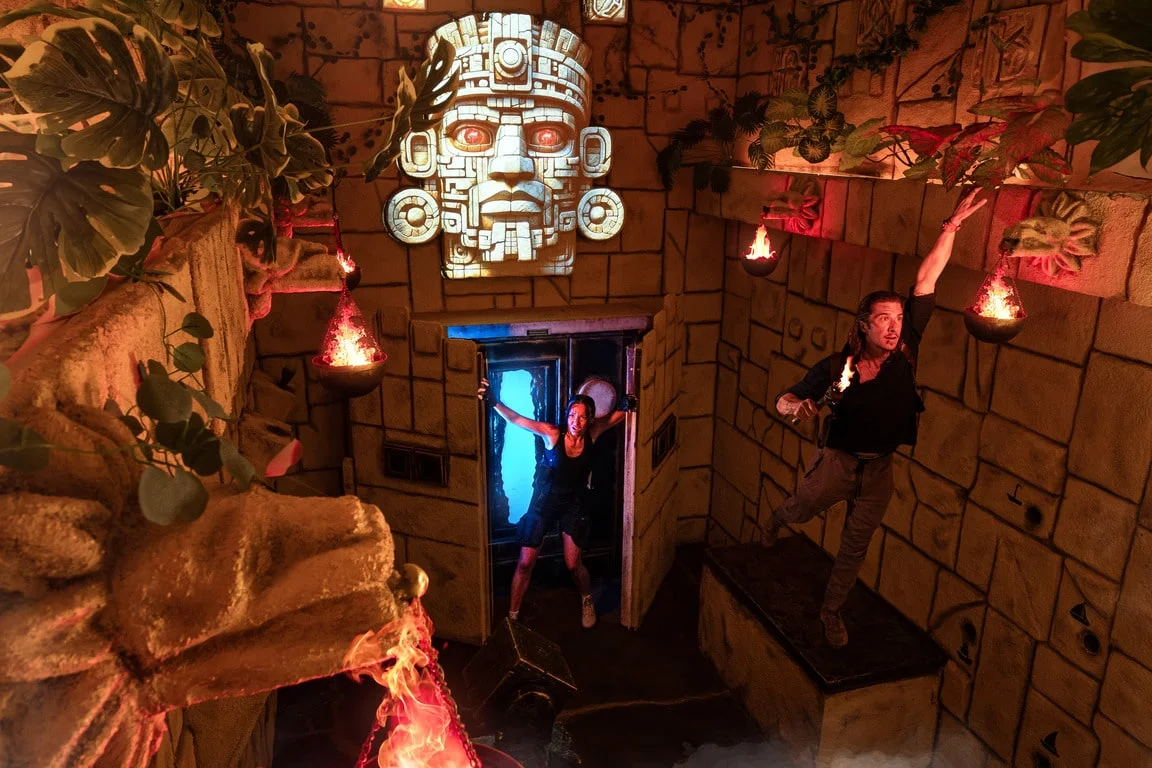
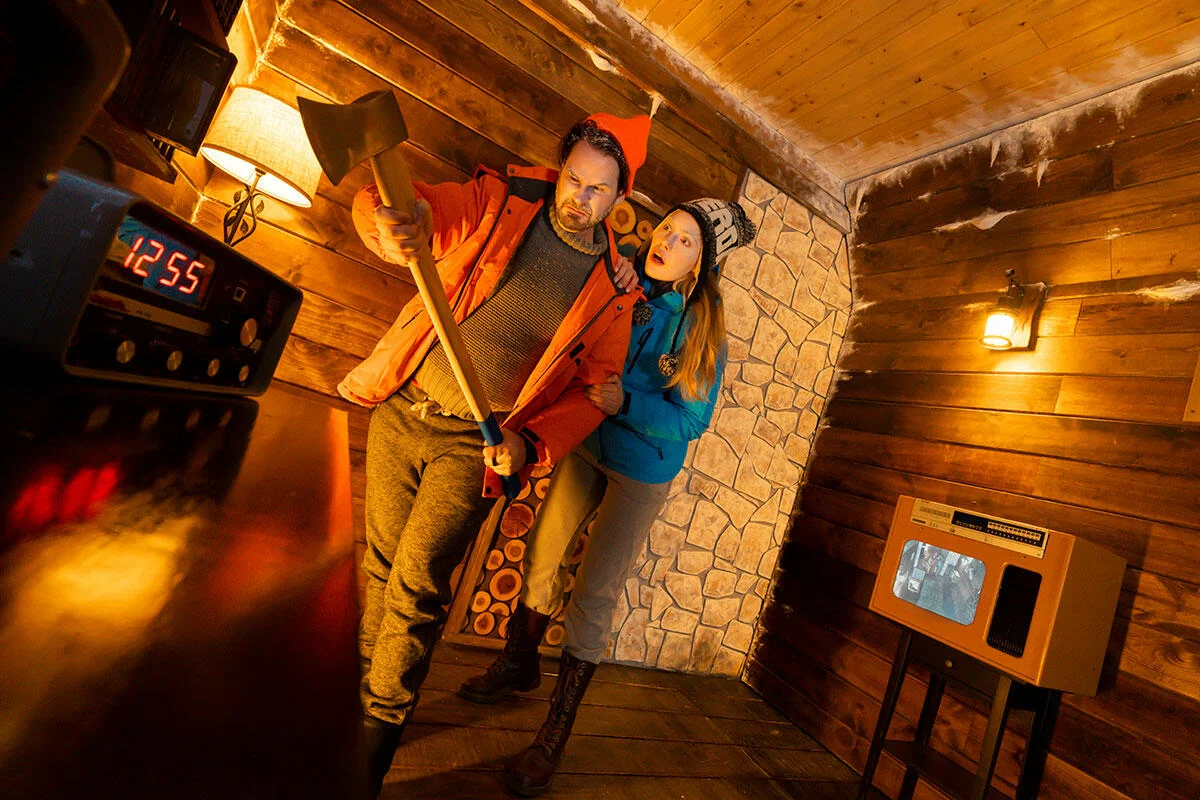
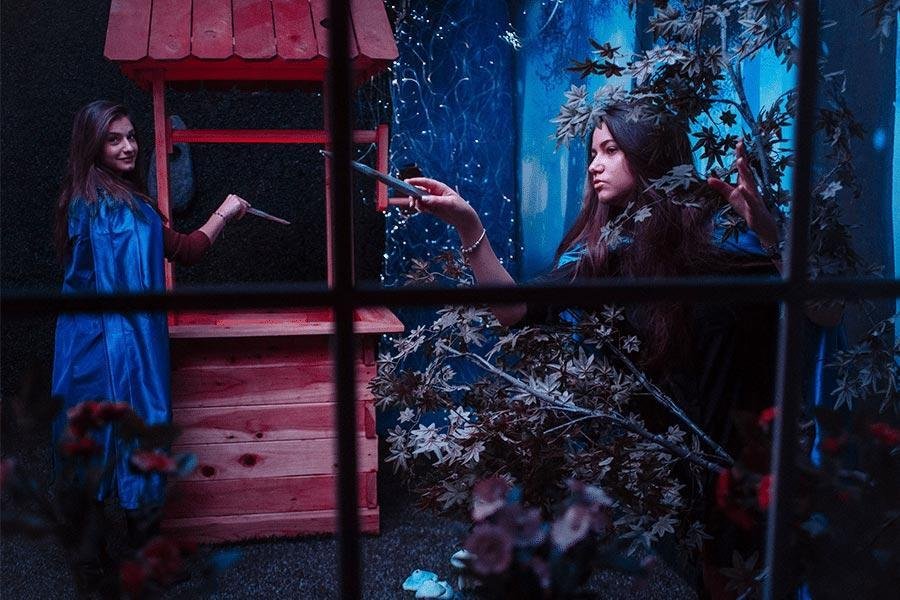
This is where the combination of LACMA museum Los Angeles and an escape room at Maze Rooms works particularly well as a day structure. The Robertson Blvd location is a short drive from LACMA Wilshire Boulevard Los Angeles CA — close enough that the transition doesn’t consume the afternoon. The escape room format is active, participatory, physical — a direct counterpoint to the museum’s observational mode. The LACMA art museum asks you to look. The escape room asks you to touch things, move through space, communicate under a clock, solve something with your hands.
Escape rooms in Los Angeles at Maze Rooms run across more than twenty themed rooms at six locations across LA — Robertson Blvd, Santa Monica Blvd in West LA, Culver City on Sepulveda, Vermont Ave, Highland Ave, and Playa Del Rey. Horror, adventure, mystery, sci-fi, Western, fantasy. Private rooms, no strangers. Prices from $37 per person. Open 10AM to 11PM daily.
For groups building a full cultural day in Los Angeles — LACMA museum in the morning, escape rooms in the afternoon, dinner in the neighborhood — the combination earns its place as a plan rather than a compromise.
Our Locations & Rooms
Highland Ave
Robertson Blvd
Santa Monica Blvd
Playa Del Rey
Vermont Ave
Sepulveda Blvd
Ventura Blvd